

Matthew 2:11 · Meaning, context & original Greek
What does Matthew 2:11 mean?
 Watch this verse in the Bible Frame app
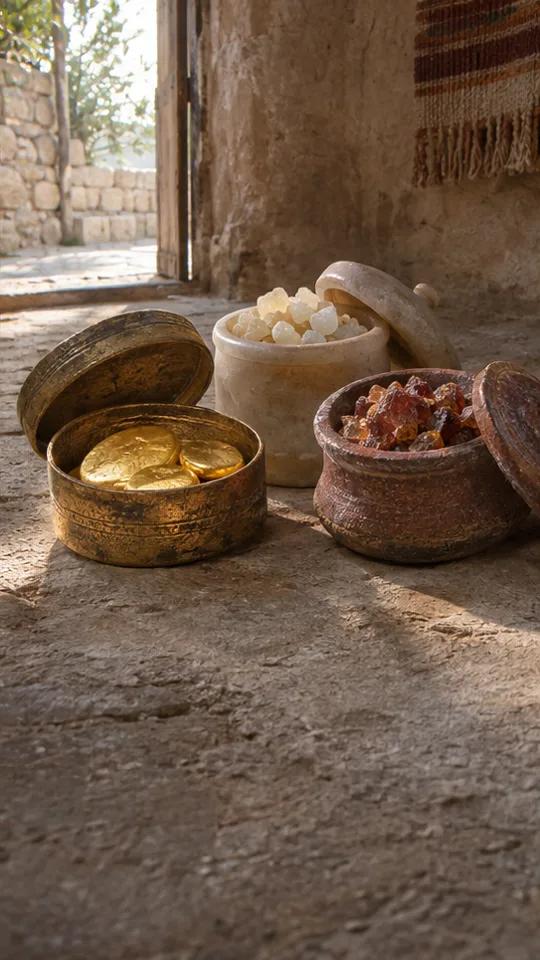
They came into the house and saw the young child with Mary, his mother, and they fell down and worshiped him. Opening their treasures, they offered to him gifts: gold, frankincense, and myrrh.
Matthew 2:11 · World English Bible, Catholic Edition (public domain)
The short answer
Matthew 2:11 tells how the wise men from the east entered the house, saw the child Jesus with Mary his mother, fell down and worshiped him, and offered gold, frankincense and myrrh. Matthew gives the gifts no explanation, and the meanings often attached to them, like the number and names of the visitors, come from later tradition.
- Who comesWise men from the east
- What they doFall down and worship
- What they giveGold, frankincense, myrrh
- Read at MassThe Epiphany
Explain it at my level
Kids
Wise men travelled a long way, following a star, to find a new king. When they found the house, they saw little Jesus with Mary, his mother. They got down low on the ground to honor him. Then they opened their boxes and gave him their best presents: gold, frankincense and myrrh. They were so glad to see him.
Key takeawayThe wise men bowed down to Jesus and gave him their best.
Simple
Wise men from the east have followed a star to Bethlehem, looking for the newborn King of the Jews. In this verse they arrive. They go into the house and see the child with his mother, Mary. They fall to the ground and worship him, then open their treasure chests and give him three costly gifts. The Bible does not say how many wise men there were, and it does not call them kings. Those details come from later tradition.
Key takeawayStrangers from far away are the first in Matthew to worship Jesus.
Standard
This verse is the goal of the journey that began in verse 1. The wise men had said they came “to worship him” (v. 2), and Herod claimed he wanted the same (v. 8). Here the worship actually happens, and it comes from foreigners. Matthew tells it plainly: a house, a child, his mother, three actions and three gifts. He adds no comment on the gifts. A Catholic study note points to Psalm 72 and Isaiah 60, where kings and nations bring gold and frankincense, and says those texts led to the later picture of the magi as kings. In the next verse a dream sends them home another way.
Key takeawayThe journey ends in worship, and Matthew leaves the gifts unexplained.
Scholar
The Greek is three participles, each carrying a main verb: having come they saw, falling they worshiped, opening they offered. The word for treasures means, in the lexicon’s first sense, a place of safe keeping, and it cites this verse for a casket. Three questions are debated. First, the verb for worship can mean homage to a ruler or adoration of God. John Gill reads civil honor here, while John Chrysostom says they offered “not as to a man, but as to God.” Second, Irenaeus and Origen read the gifts as signs of a king, of God and of one who would die, but Heinrich Meyer calls such symbolism arbitrary, and Ellicott doubts it was in the evangelist’s mind. Third, Matthew quotes no prophecy here, though he does so at verses 6 and 15, so whether he intends Isaiah 60:6 and Psalm 72 as fulfilled is inferred. Bengel sees a prediction, while the Cambridge Bible speaks only of Eastern custom.
Key takeawayThe grammar is simple, while the worship and the gifts are read in more than one way.
Key words
In the original Greek word order. Choose a word to see what it means and why it matters.
into the house
εἰς τὴν οἰκίαν eis tēn oikian
into the dwelling
Oikia is the ordinary word for a house or dwelling. Matthew does not mention a manger, which belongs to Luke’s account of the birth night (Luke 2:7). The Cambridge Bible notes that Matthew gives no hint the house was an inn. Chrysostom, by contrast, still pictures a manger and a shed in his homily.
Why it mattersMatthew’s scene is not the stable of the crib set. How long after the birth the visit came is not stated, and readers differ.
Preposition; Noun, accusative singular feminine · Strong’s G1519 + G3614G
the young child
τὸ παιδίον to paidion
the little child
Paidion means a young child, a little one. Matthew uses it nine times in this chapter, always for Jesus, and it is the word the angel uses to Joseph: take the young child and his mother. Luke’s shepherds are sent to find a baby, a different Greek word (Luke 2:12).
Why it mattersThe word fits an infant or a small child, so it does not settle his age. It keeps the reader’s eyes on how small this king is.
Noun, accusative singular neuter · Strong’s G3813
with Mary, his mother
μετὰ Μαρίας τῆς μητρὸς αὐτοῦ meta Marias tēs mētros autou
beside his mother Mary
The preposition meta means with, and the two nouns give her name and her relation to the child. Joseph is not mentioned in this verse. The pairing returns four times in the chapter as “the young child and his mother” (2:13, 2:14, 2:20, 2:21), always in that order.
Why it mattersMary is where the child is found. Bengel notes that the worship which follows is given to him, as the grammar says.
Preposition; Noun, genitive singular feminine; Noun, genitive singular feminine; Pronoun, genitive singular masculine · Strong’s G3326 + G3137G + G3384 + G846
they fell down
πεσόντες pesontes
falling to the ground
Piptō means to fall, and the form is a participle: having fallen. The same pair of verbs returns in Matthew 4:9, where the devil asks Jesus to “fall down and worship me,” and Jesus answers that worship belongs to God alone. Psalm 72:11 says “all kings shall fall down before him.”
Why it mattersThe body comes first. These travelers put themselves on the ground before a child in an ordinary house.
Aorist active participle, nominative plural masculine · Strong’s G4098
worshiped him
προσεκύνησαν αὐτῷ prosekunēsan autō
did him reverence
Proskuneō means to make obeisance, do reverence to, worship. The tagged text has it thirteen times in Matthew, three of them in this story (2:2, 2:8, 2:11), and again of the risen Jesus (28:9, 28:17). The word covers a subject’s homage to a king as well as the worship of God.
Why it mattersHow much the wise men understood is debated. Matthew’s readers, who know the end of the Gospel, see more in the act than homage.
Aorist active indicative, 3rd plural; Pronoun, dative singular masculine · Strong’s G4352 + G846
Opening
ἀνοίξαντες anoixantes
having opened
Anoigō means to open, and the lexicon cites this verse for opening treasures. It is the third participle in the sentence, after having come and having fallen. Each one leads to a main verb, so the sentence moves in three steps: they saw, they worshiped, they offered.
Why it mattersThe order matters. Worship comes before the gifts, and the gifts follow from it.
Aorist active participle, nominative plural masculine · Strong’s G455
their treasures
τοὺς θησαυροὺς αὐτῶν tous thēsaurous autōn
their treasure chests
Thēsauros means first a place of safe keeping, and the lexicon cites this verse for the sense casket; it can also mean the treasure itself. Ellicott and the Cambridge Bible both explain it here as caskets or chests. Matthew uses the same word in 6:21: “where your treasure is, there your heart will be also.”
Why it mattersThe wise men open what they had kept closed and guarded. What they carried all that way was meant for him.
Noun, accusative plural masculine; Pronoun, genitive plural masculine · Strong’s G2344 + G846
they offered to him
προσήνεγκαν αὐτῷ prosēnegkan autō
they brought him
Prospherō means to bring to, and the lexicon gives this verse under the sense to offer. Matthew uses the same verb for offering a gift at the altar (5:23) and for the offering Jesus tells a healed man to make (8:4). The pronoun is singular: to him, the child.
Why it mattersThe verb belongs to the language of worship as well as of courtesy. It suits a gift laid before God.
Aorist active indicative, 3rd plural; Pronoun, dative singular masculine · Strong’s G4374 + G846
gifts
δῶρα dōra
presents, offerings
Dōron is a gift or present. The lexicon lists this verse first and then its use for gifts and sacrifices offered to God, as in Matthew 5:23–24. Meyer notes the Eastern custom of not approaching a prince without presents, and points to Genesis 43:11 and 1 Kings 10:2.
Why it mattersA gift for a ruler was expected. Matthew’s word leaves room for more, since it is also his word for an offering to God.
Noun, accusative plural neuter · Strong’s G1435
gold
χρυσὸν chruson
gold
Chrusos is gold. Psalm 72:15 says of the king that “Sheba’s gold will be given to him,” and Isaiah 60:6 sees those from Sheba bringing “gold and frankincense.” Irenaeus and Origen read the gold as a gift for a king. Matthew himself draws no meaning from it.
Why it mattersGold is the gift everyone understands. The royal sense is ancient tradition, well grounded in the psalm, though not stated in the verse.
Noun, accusative singular masculine · Strong’s G5557
frankincense
λίβανον libanon
incense resin
Libanos is frankincense. The lexicon traces the word to a Semitic root and notes that the Greek Old Testament uses it for the Hebrew levonah, as in Exodus 30:34, where it goes into the incense of the sanctuary. In the New Testament it appears only here and in Revelation 18:13.
Why it mattersBecause incense was burned before God, Irenaeus and Origen took this gift as a sign that the child is God. That reading is tradition, not the text.
Noun, accusative singular masculine · Strong’s G3030
myrrh
σμύρναν smurnan
myrrh resin
Smurna is myrrh, which the lexicon describes as a resinous gum used as an unguent and for embalming. It appears in the New Testament only here and in John 19:39, where Nicodemus brings myrrh and aloes for the burial of Jesus. Genesis 43:11 lists myrrh among presents sent to a ruler.
Why it mattersIrenaeus and Origen saw in myrrh a sign of the child’s death. The burial link is real in John, though Matthew does not make it.
Noun, accusative singular feminine · Strong’s G4666
Where the verse sits
Matthew 2:11 is the moment the wise men reach the child they have been seeking since the start of the chapter. It stands between Herod’s false promise to worship and the dream that sends the visitors home by another road, and only Matthew tells it.
- vv. 1–2
Wise men from the east arrive in Jerusalem, asking where the newborn King of the Jews is, because they saw his star.
- vv. 3–8
Herod is troubled, learns from the chief priests and scribes that the Christ is to be born in Bethlehem, and sends the wise men there.
- vv. 9–12
You are here. The star leads them to the child; they rejoice, worship, offer their gifts and go home another way.
- vv. 13–15
Warned in a dream, Joseph takes the child and his mother to Egypt by night and stays there until Herod dies.
- vv. 16–18
Herod kills the boys of Bethlehem aged two and under, and Matthew quotes Jeremiah on Rachel weeping for her children.
- vv. 19–23
After Herod’s death the family returns, avoids Judea under Archelaus, and settles at Nazareth in Galilee.
Who the wise men were
The Greek word behind “wise men” is magoi. A Catholic study note says it first named the Persian priestly caste and came to be used of people thought to have more than human knowledge, and that Matthew’s magi are astrologers. The same word is used for a sorcerer in Acts 13:6. Matthew says only that they came “from the east.”
Two kings in one chapter
A Catholic study note dates Herod’s reign from 37 to 4 BC. He tells the wise men he wants to “come and worship him” (v. 8), then tries to kill the child. The same notes say that the troubled reaction of Jerusalem foreshadows the rejection of Jesus, and that the magi prefigure the Gentiles who will accept the gospel.
Old Testament echoes
Psalm 72 prays that kings will “fall down before him” and bring gifts, and Isaiah 60:6 pictures caravans bringing “gold and frankincense.” Matthew does not quote either passage here. The Church reads both beside this Gospel at the Mass of the Epiphany, and a Catholic study note says these texts led to the interpretation of the magi as kings.
Read Matthew 2, the whole chapter, word for word.
Common misreadings
A common reading
There were three wise men.
Closer to the text
Matthew gives no number. The Catholic Encyclopedia says some Fathers spoke of three, probably because of the three gifts, while Eastern tradition favors twelve. The names Gaspar, Melchior and Balthasar are later still; it traces them to Latin sources from the seventh century. Three is tradition.
A common reading
The wise men were kings.
Closer to the text
Matthew calls them wise men, magoi, and never kings. A Catholic study note says Psalm 72 and Isaiah 60, with their kings bringing gifts, led to that interpretation. The Catholic Encyclopedia says no Church Father held they were kings, though Tertullian wrote that the East regarded magi as kings.
A common reading
They knelt at the manger beside the shepherds.
Closer to the text
Matthew says they came “into the house,” and he mentions no manger and no shepherds; those belong to Luke 2. Herod’s order against boys of two and under (v. 16) suggests to some that time had passed. The Catholic Encyclopedia thinks about a year probable.
A common reading
The Bible says what each gift means.
Closer to the text
It does not. The reading of gold for a king, incense for God and myrrh for one who would die goes back to Irenaeus and Origen and is loved in preaching. The Catholic Encyclopedia doubts the wise men intended it, and Heinrich Meyer calls it arbitrary. It is venerable tradition.
Read it with these verses
- Psalm 72:10–11Kings of distant lands bring tribute and gifts, and all kings fall down before the royal son.
- Isaiah 60:6Caravans come to Zion from Sheba with gold and frankincense, proclaiming the praises of the LORD.
- Numbers 24:17Balaam foresees a star out of Jacob, which Justin Martyr and Origen linked with the star of the wise men.
- Matthew 4:9–10The devil asks Jesus to fall down and worship him; Jesus replies that worship is for God alone.
- Matthew 28:17At the Gospel’s end the disciples worship the risen Jesus, as the wise men did at its beginning.
- John 19:39Nicodemus brings myrrh and aloes for the burial of Jesus, the only other myrrh in the New Testament.
Live it this week
- The wise men travelled far for one moment of worship. What have you been willing to go out of your way for?
- They fell down before they opened anything. What would it mean for you to worship first and give second?
- What is the treasure you keep closed? What would it look like to open it before Christ?
A short prayer
Lord Jesus, the wise men found you with Mary your mother and fell down before you. Lead me to you by whatever light you give, and receive what I have to offer: my best, and myself. Amen.
To pray with this verse more slowly, try lectio divina, the Church’s ancient way of praying with Scripture.
Memorize it
Say the verse aloud, then hide more words. Tap a blank to peek.
Teaching Matthew 2:11
For parents, small-group leaders and preachers.
With kids
Ask: If you were going to visit a new king, what would you bring? Let the child choose a present and say why. Explain that the wise men bowed down first and gave their gifts second. Then read the Kids level together.
Small group questions
- Who uses the word worship in this chapter, and who actually does it?
- What does Matthew tell us about the gifts, and what does he leave unsaid?
- Why might Matthew begin his Gospel with foreigners who worship Jesus?
Sermon outline
- The Arrival: into the house (v. 11a)
- The Sight: the child with Mary (v. 11b)
- The Worship: they fell down (v. 11c)
- The Offering: treasures opened (v. 11d)
Questions people ask
What does Matthew 2:11 mean?
It means that the wise men’s long search ends in worship. They enter the house, see the child Jesus with Mary his mother, fall down before him and offer gold, frankincense and myrrh. In Matthew they are the first to worship Jesus, and they are foreigners. The Catechism sees in them the first of the nations to welcome the good news of salvation.
What do gold, frankincense and myrrh symbolize?
Matthew does not say. By an ancient tradition, found in Irenaeus and in Origen, whose words these are, gold was offered “as to a king,” incense “as to a God,” and myrrh “as to one who was mortal.” Many Christians read the gifts this way. The Catholic Encyclopedia notes that the Fathers found many meanings and that it is not clear any of them is inspired, and some commentators see simply costly gifts fit for a ruler.
How many wise men were there, and were they kings?
The verse gives no number and does not call them kings. Three is a tradition that probably grew from the three gifts, and the Catholic Encyclopedia notes that Eastern tradition favors twelve. The idea that they were kings came from reading Psalm 72 and Isaiah 60 beside the story. The names Gaspar, Melchior and Balthasar appear in later Latin sources.
Where did the wise men find Jesus, and how old was he?
Matthew says they found him in a house in Bethlehem, with Mary his mother. He does not give the child’s age. The word he uses means a young child, and Herod later targets boys of two years and under, so some conclude that months or more had passed since the birth. The timing is debated, and the text does not settle it.
Did the wise men worship Jesus as God?
The Greek verb can describe homage to a king or the worship of God, so the verse alone does not settle what they understood. John Chrysostom preached that they approached him as God, while John Gill read it as civil honor. The Catechism says the feast of the Epiphany celebrates the adoration of Jesus by the wise men, and Matthew ends with the disciples worshiping the risen Jesus.
When is Matthew 2:11 read at Mass?
It is part of the Gospel for the Epiphany of the Lord, Matthew 2:1–12, read every year. The first reading that day is Isaiah 60:1–6, with its gold and frankincense, and the psalm is Psalm 72, with its kings bringing gifts. So the liturgy sets beside the verse the two Old Testament passages most often heard behind it.
What does the Catholic Church teach about Matthew 2:11?
The Catechism treats the wise men in paragraph 528. It calls the Epiphany the manifestation of Jesus as Messiah of Israel, Son of God and Savior of the world, and it sees in the magi “the first-fruits of the nations.” It adds that their coming to Jerusalem shows that the nations find Jesus by turning to the Jews and receiving the messianic promise from them.
How can I explain Matthew 2:11 to a child?
Tell them that wise men followed a star for a long way to find Jesus. When they found him with his mother, Mary, they bowed right down to the floor, and then gave him the best things they had. Ask what the child would give Jesus. The Kids level above gives a short version to read aloud.
In culture
The verse stands behind much of what people picture at Christmas. The carol We Three Kings, written by the American clergyman John Henry Hopkins Jr. about 1857, gives a stanza to each gift and sings the traditional meanings, and it takes its three kings from tradition, not from Matthew. Cologne Cathedral holds a shrine with what are claimed to be the relics of the wise men, brought there in the twelfth century according to the Catholic Encyclopedia. Crib sets usually place the wise men at the manger, joining Matthew’s story to Luke’s.
Keep reading
Sources
Every verse is quoted word for word, and every Catechism paragraph below was checked on the Vatican’s published text.
Scripture
- Matthew 2:1–16
- Matthew 2:20–21
- Matthew 4:9
- Matthew 6:21
- Psalm 72:10–11
- Psalm 72:15
- Isaiah 60:6
- Matthew 2:17–23
- Matthew 4:10
- Matthew 5:23–24
- Matthew 8:4
- Matthew 28:9
- Matthew 28:17
- Luke 2:7
- Luke 2:12
- John 19:39
- Acts 13:6
- Revelation 18:13
- Genesis 43:11
- Exodus 30:34
- Numbers 24:17
- 1 Kings 10:2
- Isaiah 60:1–6
- Matthew 4:9–10
Other sources
- Catechism of the Catholic Church, 528
- Lectionary for Mass (1998 United States edition), no. 20, as indexed at catholic-resources.org
- New American Bible, introduction to Matthew and notes on Matthew 1–2 (Vatican website copy)
- Irenaeus, Against Heresies, Book 3, chapter 9, section 2 (New Advent)
- Origen, Against Celsus, Book 1, chapters 59–60 (New Advent)
- John Chrysostom, Homily 8 on Matthew (New Advent)
- Justin Martyr, Dialogue with Trypho, 106 (New Advent)
- Tertullian, Against Marcion, Book 3, chapter 13 (New Advent)
- Walter Drum, “Magi,” The Catholic Encyclopedia (1910), New Advent
- Heinrich Meyer, Commentary on Matthew 2:11 (BibleHub)
- Ellicott’s Commentary for English Readers on Matthew 2:11 (BibleHub)
- Cambridge Bible for Schools and Colleges on Matthew 2:11 (BibleHub)
- J. A. Bengel, Gnomon of the New Testament on Matthew 2:11 (BibleHub)
- John Gill, Exposition of the Bible on Matthew 2:11 (BibleHub)
- John Henry Hopkins Jr., We Three Kings (written about 1857, published 1863)
- STEPBible tagged texts and lexicon (TAGNT, TBESG), CC BY 4.0
- STEPBible.org, tagged Greek text and lexicon (CC BY 4.0), for the original words, Strong’s numbers and grammatical forms
Scripture is quoted word for word from the World English Bible, Catholic Edition. Images are artistic interpretations.