

Luke 2:7 · Meaning, context & original Greek
What does Luke 2:7 mean?
 Watch this verse in the Bible Frame app
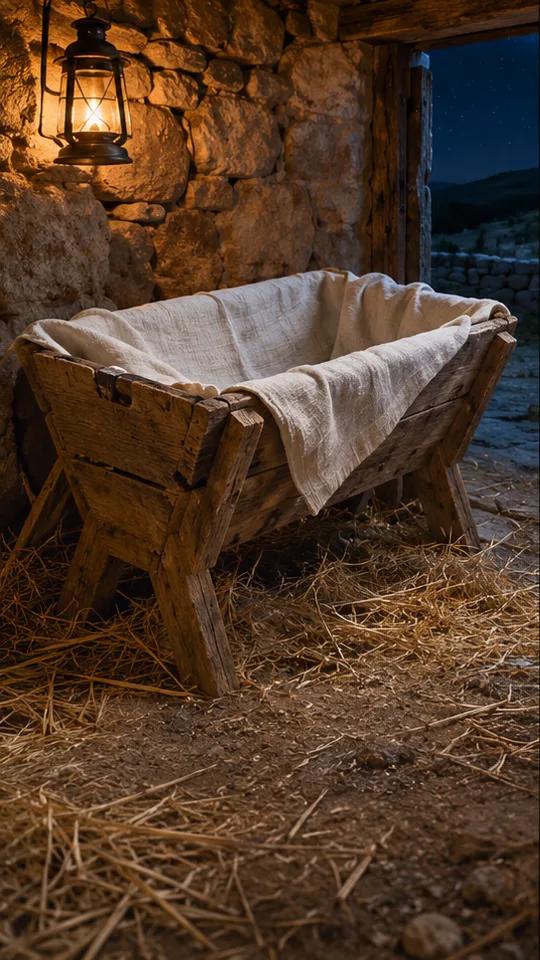
She gave birth to her firstborn son. She wrapped him in bands of cloth and laid him in a feeding trough, because there was no room for them in the inn.
Luke 2:7 · World English Bible, Catholic Edition (public domain)
The short answer
Luke 2:7 tells the birth of Jesus in one plain sentence: Mary gives birth to her firstborn son in Bethlehem, wraps him in bands of cloth and lays him in an animals’ feeding trough, since the lodging has no room for them. The child an angel will soon call Savior and Lord is given the humblest of beds.
- Who actsMary
- What happensA son is born
- Where he liesA feeding trough
- Why thereNo room for them
Explain it at my level
Kids
Mary and Joseph had gone a long way to a town called Bethlehem. While they were there, Mary’s baby was born. He was her first child. She wrapped him up snug in strips of cloth. There was no room for them in the place where people stayed, so she laid him in a box that animals ate their food from. That baby was Jesus.
Key takeawayGod’s Son had an animals’ food box for his first bed.
Simple
Luke tells the birth of Jesus very simply. Mary has her first child, a son. She wraps him snugly in cloth, the usual care for a newborn. Then she lays him in a feeding trough, a box that holds food for animals, because the place where they were staying had no space for them. Luke reports no speech and no wonder at this point. The humble bed is the detail he sets before you.
Key takeawayThe Savior’s birth is told with no wonders, only a mother’s care and a borrowed bed.
Standard
Luke has led up to this moment with an emperor’s decree and a journey to David’s town, and then he tells the birth in a single verse. Three actions belong to Mary: she gave birth, she wrapped, she laid. The word behind “inn” is the one Luke uses later for the “guest room” of the Last Supper, so the crowded place may have been a house and not a public lodging. The details matter at once. In verse 12 the angel makes the wrapped baby in the “feeding trough” the sign for the shepherds, and in verse 16 they find him just so.
Key takeawayThe trough that looks like a mere hardship becomes the sign by which the shepherds know the child.
Scholar
Three aorist verbs joined by and carry the verse, each with Mary as subject; verse 6 prepares for them with the arrival of her day. Firstborn anticipates the law of the firstborn cited at 2:23, and the same adjective is used of Christ in Romans 8:29, Colossians 1:15 and Hebrews 1:6. The verb for swaddling is found in the New Testament only here and in verse 12. The noun for feeding trough comes three times in this chapter and once more at 13:15, of an animal’s stall. The causal clause turns on a noun found elsewhere only at Mark 14:14 and Luke 22:11, of the Passover room; for a commercial inn Luke has a different word at 10:34. Whether it means an inn, a guest room or simply lodging is debated. A Catholic study note hears possible allusions to Wisdom 7:4–6 and Isaiah 1:3.
Key takeawayLuke’s vocabulary ties the manger to the shepherds’ sign and the lodging to the Passover room.
Key words
In the original Greek word order. Choose a word to see what it means and why it matters.
She gave birth
ἔτεκεν eteken
she gave birth
Eteken comes from tiktō, to give birth, in the aorist: a simple, completed act. Verse 6 has just used the same verb for the day that had come, and the angel will use it in the passive in verse 11. Luke tells the birth itself in this one word.
Why it mattersLuke gives five verses to the census and the journey, and a single word to the birth.
Aorist active indicative, 3rd singular · Strong’s G5088
son
τὸν υἱὸν αὐτῆς ton huion autēs
her son
Huion is the ordinary word for a son, here with the pronoun her. The angel had told Mary she would give birth to a son and name him Jesus (1:31), and that he would be called the Son of the Most High (1:32). This verse reports the first of those promises kept.
Why it mattersThe child is called Mary’s son here. Luke’s reader already knows whose Son he will also be called.
Noun, accusative singular masculine; Pronoun, genitive singular feminine · Strong’s G5207 + G846
firstborn
τὸν πρωτότοκον ton prōtotokon
firstborn
Prōtotokon means firstborn, the child who opens the womb. In Israel’s law the firstborn belonged to the Lord (Exodus 13:2), and Luke cites that law at 2:23. A Catholic study note calls the word a legal description that does not necessarily mean Mary had other sons.
Why it mattersThe word looks back to the law of the firstborn. By itself it says nothing about younger brothers or sisters.
Adjective, accusative singular masculine · Strong’s G4416
wrapped him in bands of cloth
ἐσπαργάνωσεν αὐτὸν esparganōsen auton
swaddled him
Esparganōsen means to wrap an infant in swaddling bands, the ordinary care given to a newborn. The verb appears in the New Testament only here and in verse 12. In Wisdom 7:4 King Solomon says that he too was nursed with care and wrapped in swaddling clothes.
Why it mattersThe bands show a mother’s care and do not by themselves signal poverty. A king’s son was wrapped the same way.
Aorist active indicative, 3rd singular; Pronoun, accusative singular masculine · Strong’s G4683 + G846
laid him
ἀνέκλινεν αὐτὸν aneklinen auton
laid him down
Aneklinen comes from anaklinō, to lay down or to make someone recline. Elsewhere in the Gospels it is used of people placed at a meal, as when Jesus has the crowd sit down on the grass (Mark 6:39) or speaks of those who will sit down in God’s Kingdom (Luke 13:29).
Why it mattersA verb used elsewhere for seating people at a meal is used here for placing a baby where animals feed.
Aorist active indicative, 3rd singular; Pronoun, accusative singular masculine · Strong’s G347 + G846
in a feeding trough
ἐν φάτνῃ en phatnē
in a manger
Phatnē is a manger, a trough from which animals feed. Luke names it three times in this chapter, in verses 7, 12 and 16, and once more at 13:15, where the same word names the stall an ox or donkey is led from. Luke mentions no animals in this scene.
Why it mattersThe word implies a place where animals were kept, but Luke names neither a stable nor a cave.
Preposition; Noun, dative singular feminine · Strong’s G1722 + G5336
because
διότι dioti
because
Dioti is a conjunction that gives a reason. It ties the clause that follows to the feeding trough: the child lies there for a reason, and the reason is a lack of space. Luke offers no other explanation and assigns no blame to anyone in Bethlehem.
Why it mattersThe reason Luke gives is practical. He does not say that anyone turned the family away.
Conjunction · Strong’s G1360
no room
οὐκ ἦν τόπος ouk ēn topos
no place
Ouk ēn topos is, word for word, there was not a place. Topos is an everyday noun for a place or a space. The verb is in the imperfect, describing how things stood for them at that time, and no person is named as the cause.
Why it mattersThe phrase describes a lack of space. It does not record a refusal or a closed door.
Negative particle; Imperfect active indicative, 3rd singular; Noun, nominative singular masculine · Strong’s G3756 + G1510 + G5117
for them
αὐτοῖς autois
for them
Autois is a plural pronoun in the dative. It takes in Mary and Joseph together, the pair named in verses 4 and 5, and the need is theirs as a family at the hour of a birth. One recent study argues that their lodging was simply too small for a birth.
Why it mattersThe shortage is told from the family’s side: the lodging had no place that suited them.
Pronoun, dative plural masculine · Strong’s G846
in the inn
ἐν τῷ καταλύματι en tō katalumati
in the lodging
Kataluma is a place where travelers stay. Elsewhere in the New Testament it is used only for the room of the Last Supper, called the “guest room” in Luke 22:11. For the inn of the Good Samaritan story Luke has a different word (10:34). Whether a public inn or a room in a house is meant here is debated.
Why it mattersThe familiar picture of a commercial inn and its keeper rests on one possible meaning of this word.
Preposition; Noun, dative singular neuter · Strong’s G1722 + G2646
Where the verse sits
Luke 2:7 is the center of a short birth account. A census ordered by Caesar Augustus has brought Joseph and Mary from Nazareth to Bethlehem, and verse 6 says her day came while they were there. The birth is told in this single verse, and the scene then shifts to shepherds.
- vv. 1–3
Caesar Augustus orders an enrollment, and everyone travels to his own city to be registered.
- vv. 4–5
Joseph goes up from Nazareth to Bethlehem, David’s city, with Mary, who is pledged to him and pregnant.
- vv. 6–7
You are here. While they are in Bethlehem her day comes; Mary gives birth, wraps her son and lays him in a feeding trough.
- vv. 8–12
An angel tells shepherds of a Savior’s birth and gives them a sign: a wrapped baby lying in a feeding trough.
- vv. 13–14
A multitude of the heavenly army praises God and announces peace on earth.
- vv. 15–20
The shepherds hurry to Bethlehem, find Mary, Joseph and the baby in the trough, and return praising God.
Inn, guest room or lodging
The word translated “inn” is broad. Luke uses it again for the “guest room” where Jesus eats the Passover, and he chooses another word for the inn in the Good Samaritan story. Some scholars therefore picture a crowded house in Bethlehem and not a public lodging, and one study argues that the word means simply a place to stay. Luke’s sentence allows more than one picture.
The law of the firstborn
In Israel’s law every firstborn belonged to the Lord: “Sanctify to me all the firstborn” (Exodus 13:2). Luke shows that he has this in mind. When the child is brought to Jerusalem, he cites the rule that every male who opens the womb is holy to the Lord (2:23). Firstborn in verse 7 prepares for that scene.
Cave, stable and animals
Luke names only a feeding trough. In the second century Justin Martyr wrote that the birth took place in a cave near the village, and in the third Origen said the cave was shown at Bethlehem. The ox and donkey of later art are traced to Isaiah 1:3, “The ox knows his owner, and the donkey his master’s crib,” which later writers applied to this scene.
Read Luke 2, the whole chapter, word for word.
Common misreadings
A common reading
An innkeeper turned Mary and Joseph away.
Closer to the text
Luke mentions no innkeeper and no refusal. He says only that there was no room for them in the place where travelers stayed, and the word for that place can mean a guest room. The innkeeper of Christmas plays does not appear in Luke’s text.
A common reading
Firstborn proves Mary later had other children.
Closer to the text
Firstborn names the child who opens the womb, with the standing that Israel’s law gave such a child (Exodus 13:2). A first child is a firstborn whether or not others follow. The word alone settles nothing about brothers or sisters.
A common reading
Jesus was born the night they reached Bethlehem.
Closer to the text
Verse 6 says, “While they were there, the day had come for her to give birth.” Luke does not say how long they had been in Bethlehem. A hurried arrival and a search for a bed that same night are not part of his account.
A common reading
Luke says Jesus was born in a stable.
Closer to the text
Luke names a feeding trough and nothing more. A stable is a reasonable inference, and the Catechism speaks of “a humble stable” (525), while writers from the second century onward speak of a cave. The verse itself describes neither.
How traditions read it
Christians of every tradition read this verse as the true human birth of God’s Son; they differ over what the word firstborn leaves open about Mary’s later life.
Catholic
Confesses Mary as ever-virgin and reads firstborn as a legal title, not a count of children. The Catechism says that James and Joseph, called brothers of Jesus, are sons of another Mary and close relations of Jesus, and that Jesus is Mary’s only son (499–501).
Eastern Orthodox
Also calls Mary ever-virgin and rejects the idea that she had other children after Jesus. Orthodox hymns and icons of the Nativity set the birth in a cave, and the Orthodox Church in America’s account of the feast says Christ was born in a cave used as a stable.
Reformed and other Protestant
John Calvin, commenting on Matthew 1:25, wrote that no well-grounded inference can be drawn from the Evangelist’s words about what happened after Christ’s birth, and he did not follow Helvidius in drawing one. Many Protestant churches today teach that the brothers of Jesus were Mary’s later children.
Read it with these verses
- Luke 2:12The angel turns the wrapped baby in the feeding trough into the sign by which shepherds find him.
- Luke 22:11Luke uses the same word for the guest room of the Last Supper as for the lodging here.
- Exodus 13:2The law that every firstborn belongs to the Lord stands behind the word firstborn in this verse.
- Wisdom 7:4Solomon recalls being swaddled like any infant, a possible allusion behind the bands of cloth.
- Isaiah 1:3The ox and donkey that know their master’s crib were later read into the manger scene.
- Luke 23:53At the end of the Gospel Jesus is again wrapped in cloth and laid down, this time in a tomb.
Live it this week
- God’s Son was laid where animals feed. Where do you find it hard to believe that God comes into plain, inconvenient places?
- There was no room for them. What could you clear this week, at home or in your calendar, to make room for someone?
- Mary wrapped and laid the child with her own hands. What small act of care is yours to keep doing?
A short prayer
Lord Jesus, you were wrapped in bands of cloth and laid in a feeding trough. I am sorry for the times I have had no room for you. Make space in me, and teach me Mary’s quiet care. Amen.
To pray with this verse more slowly, try lectio divina, the Church’s ancient way of praying with Scripture.
Memorize it
Say the verse aloud, then hide more words. Tap a blank to peek.
Teaching Luke 2:7
For parents, small-group leaders and preachers.
With kids
Ask: Where do babies sleep at your house? Then show a box or a basket and say that baby Jesus slept in a box that held food for animals. Read the verse together. Choose the Kids level above to hear the story.
Small group questions
- What three things does Mary do in this verse, and what does Luke leave unsaid?
- How do verses 12 and 16 use the details that verse 7 sets down?
- Why might Luke call the child firstborn here, given the law he cites in 2:23?
Sermon outline
- The Birth: her firstborn son (v. 7a)
- The Care: wrapped in bands of cloth (v. 7b)
- The Bed: laid in a feeding trough (v. 7c)
- The Reason: no room for them (v. 7d)
- The Sign: found just as told (vv. 12, 16)
Questions people ask
What does no room in the inn mean in Luke 2:7?
It means there was no space for Mary and Joseph, and for a birth, in the place where they were lodging. Luke does not say they were refused. The Greek word can mean an inn, a guest room or simply a place to stay, and Luke uses it later for the guest room of the Last Supper (22:11). Which meaning fits Bethlehem is debated among scholars.
What is a manger in the Bible?
A manger is a feeding trough for animals, and that is how this Bible text words it. Luke’s word can also name the stall where an animal is kept, as in Luke 13:15. Mary uses the trough as a bed for her newborn. The Italian word for a nativity scene, presepe, comes from the Latin word for manger, as Pope Francis noted in a 2019 letter.
Does firstborn mean Mary had other children?
Not by itself. Firstborn names the child who opens the womb and has legal weight in Israel’s law, whether or not other children follow. The Catholic Church teaches that Mary remained a virgin and that Jesus is her only son (Catechism 499–501). Many Protestant churches hold that the brothers of Jesus named in the Gospels were her later children. Jerome argued over this very word in the fourth century.
What are swaddling clothes?
They are strips of cloth wound snugly around a newborn. The Bible text here calls them “bands of cloth.” Swaddling was ordinary care: Ezekiel 16:4 describes a neglected infant as one who was not wrapped, and in Wisdom 7:4 King Solomon says he was swaddled too. The angel later makes the wrapping part of the sign given to the shepherds (2:12).
Was Jesus born in a stable or a cave?
Luke says neither. He names only a feeding trough, which suggests a place where animals were kept. Justin Martyr in the second century wrote of a cave near the village, and Origen in the third said the cave was shown at Bethlehem. The Catechism speaks of “a humble stable” (525). The verse itself does not decide between the two pictures.
Who wrote Luke 2:7?
The verse belongs to the Gospel according to Luke. Early Christian tradition names the author as Luke, a companion of Paul, and many scholars date the book around AD 80–90, though both points are discussed. The author says in his opening lines that he has traced everything accurately and is writing in order for a reader named Theophilus (Luke 1:3).
How is Luke 2:7 different from Luke 2:12?
Luke 2:7 is the narrator’s report of what Mary did, and Luke 2:12 is the angel’s word to the shepherds. The angel repeats the same two details, the wrapping and the feeding trough, and calls them a sign. Verse 16 then reports that the shepherds found the baby lying in the trough, so the three verses work together.
How can I explain Luke 2:7 to a child?
Start with something the child knows: where a baby sleeps. Then say that when Jesus was born there was no room where his family was staying, so his mother wrapped him up and laid him in a box that held food for animals. Choose the Kids level above to read it aloud, then read the verse together.
In culture
In 1223 Francis of Assisi kept Christmas at Greccio, a small town near Rieti in Italy, with a manger full of hay, an ox and a donkey. His first biographer, Thomas of Celano, tells the story, and Pope Francis’s 2019 letter on the nativity scene notes that there were no statues at Greccio. The Catholic Encyclopedia credits Francis with originating the Christmas crib as it is known today. Augustine, preaching on the manger centuries earlier, said that the child laid there became our food.
Keep reading
Sources
Every verse is quoted word for word, and every Catechism paragraph below was checked on the Vatican’s published text.
Scripture
- Luke 2:6
- Luke 2:7
- Luke 2:12
- Luke 22:11
- Exodus 13:2
- Isaiah 1:3
- Luke 1:3
- Luke 1:31
- Luke 1:32
- Luke 2:4
- Luke 2:5
- Luke 2:11
- Luke 2:16
- Luke 2:23
- Luke 10:34
- Luke 13:15
- Luke 13:29
- Luke 23:53
- Mark 6:39
- Mark 14:14
- Romans 8:29
- Colossians 1:15
- Hebrews 1:6
- Ezekiel 16:4
- Wisdom 7:4
- Wisdom 7:4–6
Other sources
- Catechism of the Catholic Church, 499
- Catechism of the Catholic Church, 500
- Catechism of the Catholic Church, 501
- Catechism of the Catholic Church, 525
- New American Bible notes on Luke 2 (Vatican copy)
- New American Bible, introduction to the Gospel according to Luke (Vatican copy)
- Justin Martyr, Dialogue with Trypho, chapter 78
- Origen, Against Celsus, Book 1, chapter 51
- Jerome, Against Helvidius (The Perpetual Virginity of Blessed Mary), sections 11–12
- Gospel of Pseudo-Matthew, chapter 14
- Stephen C. Carlson, “The Accommodations of Joseph and Mary in Bethlehem: Κατάλυμα in Luke 2.7,” New Testament Studies 56 (2010), 326–342
- John Calvin, Commentary on a Harmony of the Evangelists, on Matthew 1:25
- Orthodox Church in America, Questions and Answers, “The Perpetual Virginity of Mary”
- Orthodox Church in America, “The Nativity of our Lord God and Savior Jesus Christ” (feast of 25 December)
- John Breck, “Light into Darkness,” Orthodox Church in America (2 December 2005)
- Ian Paul, “Jesus was not born in a stable (honest!),” Psephizo
- Pope Francis, apostolic letter Admirabile signum (1 December 2019), 2
- Catholic Encyclopedia, “Christmas”
- STEPBible.org, tagged Greek text and lexicon (CC BY 4.0), for the original words, Strong’s numbers and grammatical forms
Scripture is quoted word for word from the World English Bible, Catholic Edition. Images are artistic interpretations.