

Home › Verses › Revelation 21:4
Revelation 21:4 · Meaning, context & original Greek
What does Revelation 21:4 mean?
 Watch this verse in the Bible Frame app
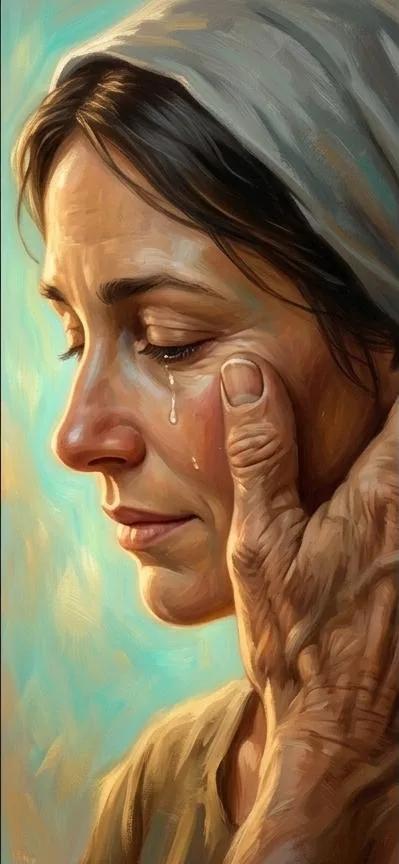
He will wipe away every tear from their eyes. Death will be no more; neither will there be mourning, nor crying, nor pain any more. The first things have passed away.”
Revelation 21:4 · World English Bible, Catholic Edition (public domain)
The short answer
Revelation 21:4 promises that when God comes to live with his people in the new creation, he himself will wipe every tear from their eyes, and death, mourning, crying and pain will be gone for good. It completes John’s vision of the new Jerusalem, echoes Isaiah 25:8 and is among the readings for Catholic funerals.
- Who actsGod himself (v. 3)
- What he doesWipes away every tear
- What endsDeath, mourning, crying, pain
- WhyThe first things are gone
Explain it at my level
Kids
John saw a picture of the future. God made everything new, and he came to live right beside his people. Then God did something gentle. Like a parent kneeling beside a crying child, he wiped the tears from their eyes. Nobody would die anymore. Nobody would be sad or get hurt anymore. All the sad things were gone for good.
Key takeawayOne day God himself will dry every tear, and sadness will be over.
Simple
Revelation is a book of visions. Near its end, John sees a new heaven and a new earth, and he hears that God will live with his people. This verse says what that will mean. God will wipe every tear from their eyes. Death will be gone, and so will mourning, crying and pain. The reason is short: the old order of things has passed away. John wrote it for Christians who were suffering.
Key takeawayTears are real now, but they are not the last word.
Standard
Verses 1–2 show a new heaven and a new earth and the holy city coming down from God. Verse 3 announces that God’s dwelling is with people. Verse 4 spells out what his presence does: he wipes away every tear, and four things end: death, mourning, crying and pain. The closing line, “The first things have passed away,” echoes verse 1, where the first heaven and earth pass away with the same verb. Verse 5 adds, “Behold, I am making all things new.” The promise takes up Isaiah 25:8, where God swallows up death and wipes away tears, and repeats Revelation 7:17, said there of those who came out of great suffering.
Key takeawayGod’s presence is the cause; the end of tears and death is the result.
Scholar
The verb exaleiphō, to blot out or wipe away, is future, continuing the futures of verse 3; Revelation also uses it in 3:5 and, with the same object, in 7:17. Traditional manuscripts add God as the subject, while the older text leaves he, with God himself from verse 3. A double ouk estai eti, will no longer be, frames the list, and nor joins its middle terms. Death comes first, recalling 20:14, where Death and Hades are thrown into the lake of fire, and Isaiah 25:8, which Paul also cites in 1 Corinthians 15:54. Penthos, mourning, is the word used three times of Babylon’s fate in 18:7–8, and ponos, pain, describes the fifth bowl in 16:10–11; here both end for God’s people. The causal hoti closes the verse, and its aorist, passed away, repeats verse 1. Augustine argued that the promise cannot describe the present age (City of God 20.17).
Key takeawayThe vision speaks of a future end as already done, with the same verb as verse 1.
Key words
In the original Greek word order. Choose a word to see what it means and why it matters.
He will wipe away
ἐξαλείψει exaleipsei
will blot out, wipe
Exaleipsei is a future of exaleiphō, which STEPBible glosses to blot out. It can mean wiping a surface clean or erasing writing. Revelation uses it in 3:5 for a name never blotted out of the book of life, and Colossians 2:14 for wiping out the record against us.
Why it mattersThe verb is gentle and decisive at once. The tear is not only dried for a moment but taken away.
Future active indicative, 3rd singular · Strong’s G1813
every tear
πᾶν δάκρυον pan dakruon
every tear
Pan dakruon is singular: every single tear, taken one at a time. Dakruon is the ordinary word for a tear. Hebrews 5:7 uses it of Jesus, who prayed with strong crying and tears, and Revelation 7:17 makes this same promise with these same two words.
Why it mattersThe singular makes the promise personal. No grief is too small or too private to be included.
Adjective, accusative singular neuter; Noun, accusative singular neuter · Strong’s G3956 + G1144
from their eyes
ἐκ τῶν ὀφθαλμῶν αὐτῶν ek tōn ophthalmōn autōn
out of their eyes
Ek tōn ophthalmōn autōn is literally out of the eyes of them. Older manuscripts read ek, out of, and traditional ones read a different word for from. The picture is close and physical: God’s hand at each face, more than a distant decree that sorrow is cancelled.
Why it mattersThe image is of personal care. God does not only abolish grief in general; he attends to each person.
Preposition; Noun, genitive plural masculine; Pronoun, genitive plural masculine · Strong’s G1537 + G3788 + G846
Death
ὁ θάνατος ho thanatos
death
Ho thanatos, death, has the article, as in 20:14, where Death and Hades are thrown into the lake of fire. Death comes first in the list, before the sorrows that follow from it. Paul calls it the last enemy to be abolished (1 Corinthians 15:26).
Why it mattersDeath is not treated as natural or neutral here. It is an enemy, and its end is the first thing named.
Noun, nominative singular masculine · Strong’s G2288
will be no more
οὐκ ἔσται ἔτι ouk estai eti
will not be still
Ouk estai eti is literally will not be any longer. Estai is the future of the verb to be, and eti means still or any longer. The same three words return at the end of the list, so mourning, crying and pain stand framed between two statements that they will be no more.
Why it mattersThe phrase is about permanence. These things do not pause; they stop existing.
Negative particle; Future middle deponent indicative, 3rd singular; Adverb · Strong’s G3756 + G1510 + G2089
mourning
πένθος penthos
grief, mourning
Penthos is grief, especially mourning for the dead. In chapter 18 the same word comes three times for the mourning that falls on Babylon, the city that boasted it would never see it (18:7–8). Here mourning ends for God’s people instead of falling on them.
Why it mattersMourning is the grief of losing someone. The promise names it directly, which is one reason it is read at funerals.
Noun, nominative singular neuter · Strong’s G3997
crying
κραυγή kraugē
outcry, crying
Kraugē is a loud cry or outcry, more than quiet weeping. Hebrews 5:7 uses it for the strong crying with which Jesus prayed, joined there with tears, and Ephesians 4:31 for angry outcry. Here it is the cry of distress that will no longer be heard.
Why it mattersIsaiah 65:19 had promised that the voice of crying would be heard no more in Jerusalem. John sees that promise kept.
Noun, nominative singular feminine · Strong’s G2906
pain
πόνος ponos
pain, toil
Ponos means pain or hard toil. Elsewhere in Revelation it describes the pain of those under the fifth bowl, who gnawed their tongues and still did not repent (16:10–11). In the new creation the same word names something that has ended.
Why it mattersPain here covers the body’s suffering and the strain of labor. Neither remains.
Noun, nominative singular masculine · Strong’s G4192
any more
οὐκ ἔσται ἔτι ouk estai eti
no longer
The second ouk estai eti closes the list as the first opened it. Revelation 22:3 uses the same three words once more, of the curse that will be no more. The repetition gives the end of these things the same certainty as their naming.
Why it mattersThe double frame is deliberate. John says twice that these things will not return.
Negative particle; Future middle deponent indicative, 3rd singular; Adverb · Strong’s G3756 + G1510 + G2089
The first things
ὅτι τὰ πρῶτα hoti ta prōta
because the former things
Hoti, because, opens the clause in most editions, though the English starts a new sentence. Ta prōta is the first or former things, neuter plural. Verse 1 used the same adjective for the first heaven and the first earth, so the old order as a whole is meant.
Why it mattersThe reason given is not that grief was unimportant, but that the world which produced it has passed.
Conjunction; Adjective, nominative plural neuter · Strong’s G3754H + G4413H
have passed away
ἀπῆλθαν apēlthan
went away
Apēlthan is an aorist of aperchomai, to go away. It is the same verb used in verse 1 of the first heaven and earth. Spoken from inside the vision, the past tense presents the end of the old order as already done.
Why it mattersThe past tense gives certainty to a future promise. In the vision, it has already happened.
Aorist active indicative, 3rd plural · Strong’s G565
Where the verse sits
Revelation 21:4 comes near the end of the book, in John’s vision of a new heaven, a new earth and the holy city coming down from God. It finishes the loud voice of verse 3, which announces that God will dwell with people, and says what his presence will mean: no more tears, death or pain.
- 20:11–15
The dead are judged before a great white throne, and Death and Hades are thrown into the lake of fire.
- 21:1–2
A new heaven and earth replace the first, and the holy city, New Jerusalem, comes down like a bride.
- 21:3
A loud voice announces that God’s dwelling is with people, and that he will be with them as their God.
- 21:4
You are here. God wipes away every tear; death, mourning, crying and pain are gone, for the first things have passed.
- 21:5–8
The one on the throne makes all things new, offers the water of life freely and warns those who refuse.
- 21:9–22:5
The city is described, with its gates, its light, the river and tree of life, and God’s servants seeing his face.
Written to churches under pressure
John writes to seven assemblies in Asia as their “brother and partner with you in the oppression” (1:9), on the island of Patmos. The Catholic study introduction calls the book resistance literature, written to Christians facing persecution by the Roman authorities. This promise was first heard by people with real reasons for tears, and it is meant to help them stand firm.
Isaiah behind the verse
John’s words gather several promises from Isaiah. Isaiah 25:8 says God has swallowed up death forever and will wipe away tears from all faces. Isaiah 65:17–19 promises new heavens and a new earth, and a Jerusalem where weeping and crying are heard no more. Revelation 21 sets these hopes in one scene, with God himself present.
Symbol and promise
Revelation speaks in visions, and the Catholic study introduction warns that its symbolic descriptions are not to be taken as literal descriptions. The Catechism likewise says the Church knows neither the moment nor the way the universe will be transformed (1048). What the vision does assert plainly is the end of death and grief in God’s presence, quoted in Catechism 1044.
Common misreadings
A common reading
If God wipes away tears, Christians should not grieve now.
Closer to the text
The verse is a future promise, not a rule for the present. Jesus himself wept at Lazarus’s tomb (John 11:35). Augustine argued that no saint lives without tears in this life, and that the holier a person is, the more tearful their prayer.
A common reading
The world will be thrown away and replaced.
Closer to the text
Verse 5 says, “Behold, I am making all things new,” not that God makes all new things. The Catechism teaches that the visible universe is destined to be transformed (1047), and that hoping for a new earth should spur concern for this one (1049).
A common reading
This describes the soul’s life right after death.
Closer to the text
The vision comes after the last judgment (20:11–15) and the arrival of a new heaven and earth. The Catechism places it at the end of time, when the Kingdom comes in its fullness (1042–1044). It concerns the final renewal, including the resurrection of the body.
Read it with these verses
- Isaiah 25:8The source of the image: God swallows up death forever and wipes away tears from all faces.
- Revelation 7:17The same promise earlier in the book, for those who came out of great suffering.
- Isaiah 65:17–19New heavens and a new earth, and a Jerusalem where weeping and crying are heard no more.
- 1 Corinthians 15:54–55Paul quotes Isaiah too: death swallowed up in victory, its sting gone.
- John 11:35Jesus weeps at his friend’s tomb; the God who will dry tears first shared them.
- Romans 8:21Paul’s hope for creation itself, set free from decay rather than discarded.
Live it this week
- What grief are you carrying that you have not yet brought to God in prayer?
- Who near you is mourning? What could you do this week simply to be with them in it?
- How does the promise that death will be no more change the way you think about your own death, or a loved one’s?
A short prayer
God, you see every tear I have cried and every one I hold back. Stay near me in my grief, and keep my hope fixed on the day when you will wipe them away and death will be no more. Amen.
To pray with this verse more slowly, try lectio divina, the Church’s ancient way of praying with Scripture.
Memorize it
Say the verse aloud, then hide more words. Tap a blank to peek.
Teaching Revelation 21:4
For parents, small-group leaders and preachers.
With kids
Ask: Who helps you when you cry, and what do they do? Talk about a parent wiping a child’s tears. Then read the verse and the Kids level together, and explain that God promises to do this for his people one day, when sad things end.
Small group questions
- How do verses 1 and 3 prepare for what verse 4 promises?
- What does Isaiah 25:8 add when you read it beside this verse?
- Why might John’s first readers, sharing in oppression (1:9), have needed this promise?
Sermon outline
- The presence: God dwells with his people (v. 3)
- The comfort: every tear wiped away (v. 4a)
- The ending: death, mourning, crying and pain (v. 4b)
- The reason: the first things have passed (v. 4c)
- The renewal: all things made new (v. 5)
Questions people ask
Who wrote Revelation 21:4?
The author calls himself John (1:1, 4, 9; 22:8). Justin, Irenaeus and other early Fathers identified him as John the apostle, while Dionysius of Alexandria denied it and Eusebius thought another John may have written it, so authorship is debated. The Catholic study introduction suggests he may have been a disciple of the apostle, and dates the book probably near the end of Domitian’s reign, which matches Irenaeus (Against Heresies 5.30.3).
Is Revelation 21:4 about heaven?
It is about the final state after the last judgment, which Revelation calls a new heaven and a new earth, with God dwelling among his people. The Catechism quotes this verse when it describes that renewed universe (1044). Christians often apply it to heaven, but the vision itself pictures God coming to live with people in a renewed creation.
Why is Revelation 21:4 read at funerals?
Because it promises the end of death and mourning. The Catholic Lectionary for Masses for the Dead lists Revelation 21:1–5a, 6b–7 among its first readings for the Easter season, and Revelation 21:1a, 3–5a among those for the funeral of a baptized child. Revelation 21:1–5a is also the second reading on the Fifth Sunday of Easter in Year C.
How is Revelation 21:4 different from Revelation 7:17?
Both promise that God will wipe away every tear from their eyes. Revelation 7:17 is said of a great multitude who came out of great suffering, with the Lamb shepherding them to springs of water. Revelation 21:4 widens the promise to the whole new creation and adds that death, mourning, crying and pain will be no more.
Does Revelation 21:4 quote Isaiah?
It echoes Isaiah closely without quoting it word for word. Isaiah 25:8 says God has swallowed up death forever and will wipe away tears from all faces, and Isaiah 65:19 says weeping and crying will be heard no more in Jerusalem. John joins these hopes in one scene, with God present among his people.
Is it wrong to grieve if God will wipe away every tear?
No. The verse promises a future comfort; it does not forbid tears now. Jesus wept at the death of Lazarus (John 11:35). Pope Francis, citing this verse with Isaiah 25:8, said at a 2016 prayer vigil, “If God could weep, then I too can weep, in the knowledge that he understands me.”
How can I explain Revelation 21:4 to a child?
Start with what happens when a child cries and a parent wipes the tears away. Explain that God promises to do that for his people one day, and that then no one will die or be hurt anymore. Choose the Kids level above to read a version aloud, and let the child talk about what makes them sad.
Keep reading
I heard a loud voice out of heaven saying, “Behold, God’s dwelling is with people; and he will dwell with them, and they will be his people, and God himself will be with them as their God.
Next · Revelation 21:5He who sits on the throne said, “Behold, I am making all things new.” He said, “Write, for these words of God are faithful and true.”
Sources
Every verse is quoted word for word, and every Catechism paragraph below was checked on the Vatican’s published text.
Scripture
- Revelation 21:1–5
- Revelation 7:17
- Revelation 1:9
- Revelation 1:1
- Revelation 1:4
- Revelation 3:5
- Revelation 7:14
- Revelation 16:10–11
- Revelation 18:7–8
- Revelation 20:11–15
- Revelation 21:6–8
- Revelation 22:3
- Revelation 22:8
- Isaiah 25:8
- Isaiah 35:10
- Isaiah 65:17–19
- 1 Corinthians 15:26
- 1 Corinthians 15:54–55
- John 11:35
- Hebrews 5:7
- Colossians 2:14
- Ephesians 4:31
- Romans 8:21
Other sources
- Catechism of the Catholic Church, 1042–1049
- Augustine, City of God, Book 20, chapter 17 (New Advent)
- Irenaeus, Against Heresies, Book 5, chapter 30, 3 (New Advent)
- Francis, Meditation at the Prayer Vigil to Dry the Tears, 5 May 2016 (vatican.va)
- New American Bible (Vatican copy), introduction to the Book of Revelation
- Felix Just, Lectionary for Mass, Masses for the Dead (US Lectionary, 2002, nos. 1012.4 and 1018.2)
- USCCB daily readings, Fifth Sunday of Easter, Lectionary no. 54, 18 May 2025 (Internet Archive copy)
- Justin Martyr, Dialogue with Trypho, chapter 81 (New Advent)
- Eusebius, Church History, Book 3, chapter 39, and Book 7, chapter 25 (New Advent)
- STEPBible.org, tagged Greek text and lexicon (CC BY 4.0), for the original words, Strong’s numbers and grammatical forms
Scripture is quoted word for word from the World English Bible, Catholic Edition. Images are artistic interpretations.