

Psalm 23 · Meaning, context & original Hebrew
What does Psalm 23 mean?
 Watch this verse in the Bible Frame app
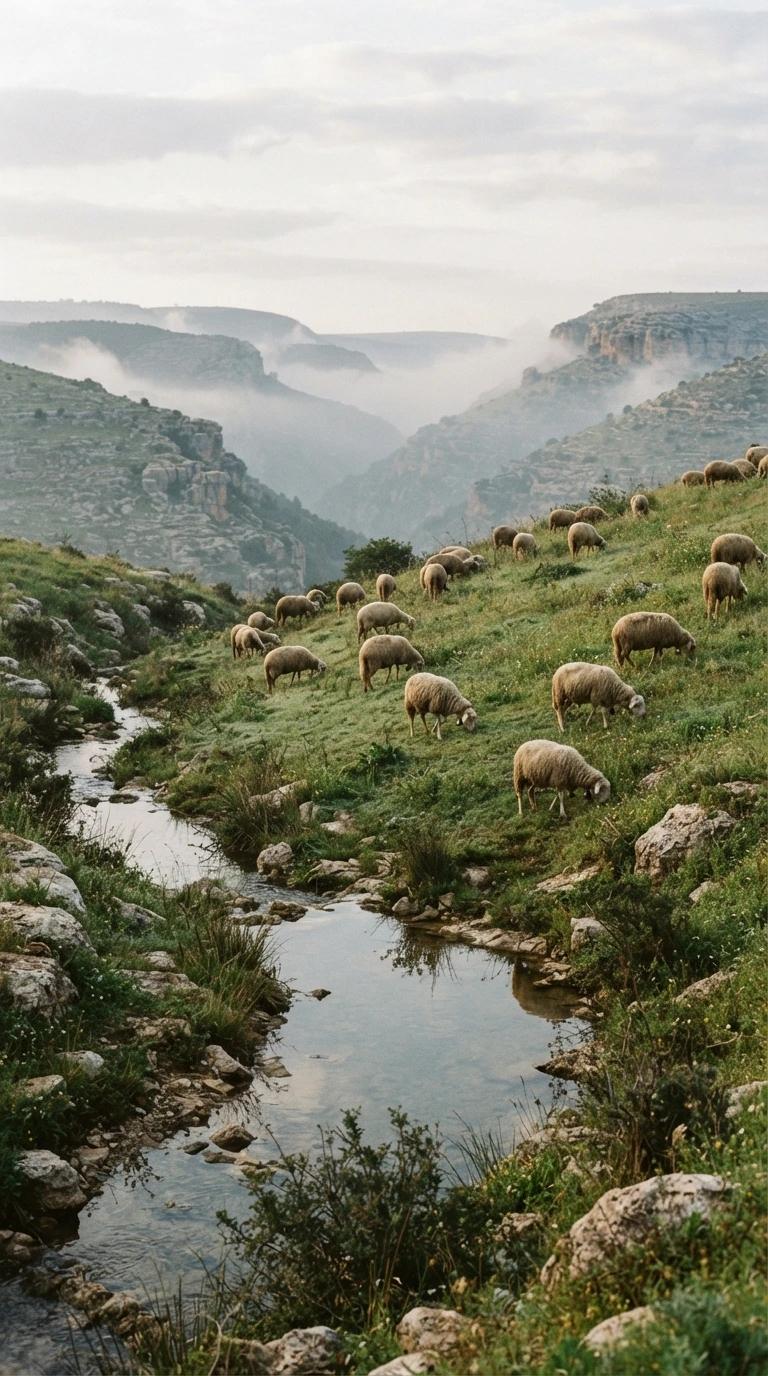
A Psalm by David.1The LORD is my shepherd; I shall lack nothing.2He makes me lie down in green pastures. He leads me beside still waters.3He restores my soul. He guides me in the paths of righteousness for his name’s sake.4Even though I walk through the valley of the shadow of death, I will fear no evil, for you are with me. Your rod and your staff, they comfort me.5You prepare a table before me in the presence of my enemies. You anoint my head with oil. My cup runs over.6Surely goodness and loving kindness shall follow me all the days of my life, and I will dwell in the LORD’s house forever.
Psalm 23 · World English Bible, Catholic Edition (public domain)
The short answer
Psalm 23 is a prayer of trust that pictures the LORD first as a shepherd who leads and protects, then as a host who welcomes and honors. It says that God’s closeness, even in the darkest valley, is the reason the one praying need not fear.
- Who praysDavid, by tradition
- The picturesShepherd and host
- Turning point“You are with me”
- The moodTrust, not denial
Explain it at my level
Kids
A shepherd looks after his sheep. He finds them grass and water, and he stays close when the path gets dark and scary. This psalm says God is like that shepherd for us. Then God is like a kind host who makes a special meal. We never have to be alone.
Key takeawayGod stays close to us, even when things feel dark.
Simple
The person praying this psalm compares God to a shepherd who finds food, water and safe paths for his flock. Even walking through a very dark valley, the person is not afraid, because God is there. Then the picture changes to a generous host who sets a table, pours oil and fills the cup. The psalm ends with the hope of living with God.
Key takeawayTrust does not mean nothing goes wrong. It means God is with you when it does.
Standard
The psalm moves through two pictures. In verses 1–4 the LORD is a shepherd who feeds, leads and guards. In verses 5–6 he is a host who prepares a table, anoints and fills the cup, in full view of enemies. The center is verse 4. There the speech changes from he to you, and the reason for courage is stated: “you are with me.” The valley is not removed; the shepherd walks through it with his sheep. The closing verse says goodness and loving kindness will follow, and the psalm ends in the LORD’s house.
Key takeawayThe psalm does not promise a life without dark valleys. It promises company in them.
Scholar
Many scholars read two images, shepherd (vv. 1–4) and host (vv. 5–6), and the USCCB’s notes trace both to exodus traditions, including a table in the wilderness (78:19). The address turns from he to you at verse 4. The word behind shadow of death is pointed as a compound, death-shadow, though its origin is debated, and it can mean deep darkness. In verse 6 the verb behind follow is the usual word for pursue. The Hebrew vowels there give I will return, while a small vowel change gives dwell, as the ancient versions read; Benedict XVI suggests both meanings may be retained. The last phrase reads for length of days. The heading can mean by, for or belonging to David, so authorship is debated. Shepherd was also royal language (cf. 2 Samuel 5:2), and scholars debate how much of that lies behind verse 1.
Key takeawayThe tender images carry exodus echoes and, for many readers, royal ones.
Key words
In the original Hebrew word order, read right to left. Choose a word to see what it means and why it matters.
The LORD is my shepherd
יְהוָ֥ה רֹ֝עִ֗י YHWH ro’i
the LORD, my shepherd
Hebrew has no is here: the divine name stands next to a participle, one who shepherds me, with the suffix my. The same verb means to feed or pasture a flock. Genesis 48:15 uses it of God, and shepherd is also language for kings.
Why it mattersMy makes this personal. The God of Israel is described as attending to one person’s next meal and next step.
Proper noun; Qal participle, masculine singular construct, with 1st person singular suffix · Strong’s H3068 + H7462
I shall lack nothing
לֹ֣א אֶחְסָֽר lo’ 'echsar
I will not lack
Chaser means to lack or be without. Israel used this verb for the wilderness years, when it says they lacked nothing (Deuteronomy 2:7). It is the first thing the psalm draws from having this shepherd, and it describes what is needed along his way.
Why it mattersIt is a statement of trust about what the shepherd provides, not a promise of everything a person wants.
Negative particle; Qal imperfect, 1st person common singular · Strong’s H3808 + H2637
green pastures
בִּנְא֣וֹת דֶּ֭שֶׁא bin’ot deshe’
pastures of fresh grass
The Hebrew is literally pastures of grass, using a word for fresh young growth. In dry country such grass cannot be taken for granted. Benedict XVI notes that a shepherd in a largely desert land must know where to find it.
Why it mattersThe picture is not of a lush estate, but of a guide who finds life where it is scarce.
Noun, feminine plural construct; Noun, masculine singular absolute · Strong’s H4999 + H1877
still waters
מֵ֖י מְנֻח֣וֹת mei menuchot
waters of rest
Mei menuchot is literally waters of rest. The second word means rest or a resting place, not only calm surface water. So the phrase can describe water where the flock is able to stop and be refreshed.
Why it mattersThe gift is rest as well as drink: the flock does not have to keep running.
Noun, masculine plural construct; Noun, feminine plural absolute · Strong’s H4325 + H4496
He restores my soul
נַפְשִׁ֥י יְשׁוֹבֵ֑ב nafshi yeshovev
he restores my life
Nefesh, translated soul, also means self, life or breath, so it is broader than an inner spiritual part. The verb is a form of shuv, to return, in the sense of bringing back or restoring. Verse 6 may use the same root.
Why it mattersThe whole person is in view here: the one who is worn down is brought back to life.
Noun, feminine singular construct, with 1st person singular suffix; Piel imperfect, 3rd person masculine singular · Strong’s H5315 + H7725
paths of righteousness
בְמַעְגְּלֵי־צֶ֝֗דֶק vema’gelei tzedek
right tracks
The word for paths means tracks, and tzedek means rightness or justice. So the phrase can mean right paths as well as morally upright ways. The USCCB’s note says it connotes both right way and way of righteousness.
Why it mattersBoth senses matter: the shepherd’s road is the road that truly leads home, and it is a good road.
Noun, masculine plural construct; Noun, masculine singular absolute · Strong’s H4570 + H6664
for his name’s sake
לְמַ֣עַן שְׁמֽוֹ lema’an shemo
for his name
Lema’an shemo gives the shepherd’s motive. In the Bible a name stands for a person’s character and reputation. God leads because of who God is, and the phrase looks past anything the sheep have done.
Why it mattersThe security in this psalm rests on God’s faithfulness to himself, not on the sheep’s performance.
Conjunction; Noun, masculine singular construct, with 3rd person singular suffix · Strong’s H4616 + H8034
valley of the shadow of death
בְּגֵ֪יא צַלְמָ֡וֶת begei’ tzalmavet
valley of deep darkness
Tzalmavet is pointed as a compound of shadow and death, and lexicons give both death-shadow and deep darkness. Its origin is debated. Benedict XVI says the phrase calls to mind the shadows of death, and so a place of anguish, terrible threats and the danger of death.
Why it mattersThe valley includes death, but the psalm can be prayed in any dark place a person has to walk through.
Noun, common singular construct; Noun, masculine singular absolute · Strong’s H1516 + H6757
you are with me
כִּי־אַתָּ֥ה עִמָּדִ֑י ki 'atah 'imadi
you, with me
Hebrew has no are here: the clause is simply you, with me. This is the point where the psalm turns from speaking about God to speaking to him. Benedict XVI calls these words a proclamation of steadfast faith.
Why it mattersThe reason for courage is a presence, not a change of circumstances. The valley remains.
Conjunction; Personal pronoun, 2nd person masculine singular; Preposition, with 1st person singular suffix · Strong’s H3588 + H859 + H5978
Your rod and your staff
שִׁבְטְךָ֥ וּ֝מִשְׁעַנְתֶּ֗ךָ shivtekha umish’antekha
your club, your staff
Shevet can mean a rod, club or scepter, and a shepherd’s rod could defend the flock. Mish’enet is a support or staff to lean on. Benedict XVI pictures the sheep hearing its reassuring beat on the ground.
Why it mattersThese tools comfort because they protect and guide. The rod here is not chiefly a picture of punishment.
Noun, masculine singular construct, with 2nd person singular suffix; Noun, feminine singular construct, with 2nd person singular suffix · Strong’s H7626 + H4938
You prepare a table
תַּעֲרֹ֬ךְ לְפָנַ֨י שֻׁלְחָ֗ן ta’arokh lefanai shulchan
you arrange a table
The verb means to set in order, and Psalm 78:19 uses it with table when Israel challenges God, asking if he can prepare one in the wilderness. Benedict XVI notes that the Hebrew word first meant an animal skin spread on the ground.
Why it mattersGod’s hospitality takes place while danger is still present, and it does not wait until the enemies are gone.
Qal imperfect, 2nd person masculine singular; Noun, masculine plural construct, with 1st person singular suffix; Noun, masculine singular absolute · Strong’s H6186 + H6440 + H7979
You anoint my head with oil
דִּשַּׁ֖נְתָּ בַשֶּׁ֥מֶן רֹ֝אשִׁ֗י dishanta vashemen roshi
you refresh my head
Dishen comes from a root meaning to be fat or prosperous, and here means to refresh or enrich with oil. The USCCB note describes perfumed olive oil used especially at banquets. This is a host’s honor to a guest.
Why it mattersIt is a gesture of welcome and celebration, which goes beyond what a guest strictly needs.
Piel perfect, 2nd person masculine singular; Noun, masculine singular absolute; Noun, masculine singular construct, with 1st person singular suffix · Strong’s H1878 + H8081 + H7218
My cup runs over
כּוֹסִ֥י רְוָיָֽה kosi revayah
my cup, saturation
The Hebrew has no verb, only two nouns: my cup, abundance. Revayah means saturation or abundance. Benedict XVI hears in the whole scene gifts that go beyond what is strictly necessary and express love’s abundance.
Why it mattersThe psalm begins with lacking nothing and arrives here at more than enough.
Noun, feminine singular construct, with 1st person singular suffix; Noun, feminine singular absolute · Strong’s H3563 + H7310
goodness and loving kindness
ט֤וֹב וָחֶ֣סֶד tov vachesed
goodness and covenant love
Tov is goodness, and chesed is the Bible’s word for loyal, covenant love, the love God names in Exodus 34:6. The USCCB note calls this pair the blessings of God’s covenant with Israel, so it describes more than general good fortune.
Why it mattersWhat follows the person praying is not luck but God’s faithful love.
Adjective, masculine singular absolute; Noun, masculine singular absolute · Strong’s H2896 + H2617
shall follow me
יִ֭רְדְּפוּנִי yirdefuni
they will pursue me
Radaf is the usual Hebrew verb for pursuing or chasing, and it can also mean to persecute. The enemies appear in verse 5, but in verse 6 it is goodness and loving kindness that are on the speaker’s heels.
Why it mattersThis is the psalm’s surprise: the one being chased is being chased by God’s love.
Qal imperfect, 3rd person masculine plural, with 1st person singular suffix · Strong’s H7291
dwell in the LORD’s house forever
וְשַׁבְתִּ֥י בְּבֵית־יְ֝הוָ֗ה לְאֹ֣רֶךְ יָמִֽים veshavti beveit YHWH le’orekh yamim
return to God’s house
The Hebrew vowels give I will return, and a small change gives I will dwell, as ancient versions read. Benedict XVI says both meanings may be retained. The end of the verse is literally for length of days.
Why it mattersThe journey has a destination: being at home with God. Christians also hear in it life beyond death.
Qal perfect with waw, 1st person common singular; Noun, masculine singular construct; Proper noun; Noun, masculine singular construct; Noun, masculine plural absolute · Strong’s H7725 + H1004 + H3068 + H753 + H3117
Where the verse sits
Psalm 23 follows the anguished Psalm 22, which opens with “My God, my God, why have you forsaken me?” and comes before Psalm 24’s question of who may ascend the LORD’s hill. Its heading is short, and it has no story attached, so its setting has to be read from its images.
- heading
The Hebrew heading calls it a psalm of David, so tradition reads it as his prayer.
- vv. 1–3
The LORD is a shepherd who provides food, water, rest and right paths for his name’s sake.
- v. 4
In the dark valley the speech turns to you: God’s presence removes fear, not the valley.
- v. 5
The picture changes to a host who sets a table and honors a guest before enemies.
- v. 6
Goodness and loving kindness follow the speaker, and the journey ends in the LORD’s house.
Why some Bibles call it Psalm 22
Hebrew and Greek-Latin Bibles number most of the psalms differently, because they divide some psalms in different places. So Benedict XVI calls this “Psalm 23 [22, according to the Greco-Latin numbering].” Older Catholic Bibles and some liturgical books still say Psalm 22. It is the same prayer. This page uses the Hebrew numbering.
Shepherds and kings
Shepherding was daily work, and David himself kept sheep (1 Samuel 17:34). It was also royal language. Benedict XVI points out that David was chosen as a shepherd of God’s people, and he links the image to the exodus and the return from exile. Many scholars also hear kingship in calling the LORD my shepherd, though how much is debated.
Two pictures or one?
Many readers find a shepherd in verses 1–4 and a host in verses 5–6, as the USCCB’s notes do. Others read one pastoral scene throughout, since a shepherd might also lead a flock to a prepared place. Benedict XVI calls verse 5 a different scene but keeps it in the desert, before the shepherd’s tent. The transition is debated, but the sense of being cared for holds.
Read Psalm 23, the whole chapter, word for word.
Common misreadings
A common reading
The valley only means the moment of dying.
Closer to the text
The Hebrew phrase can mean deep darkness as well as death-shadow. Benedict XVI applies it to suffering, doubt and every kind of human trouble. Praying it at a deathbed is right, but the psalm is not limited to that hour.
A common reading
Lacking nothing means God gives whatever I want.
Closer to the text
The line comes from a sheep’s view of its shepherd: enough food, water and guidance on his paths. A dark valley and enemies are still part of the same psalm. It speaks of trust and provision, without promising that every wish is granted.
A common reading
The rod in verse 4 is for punishing the sheep.
Closer to the text
Elsewhere in Scripture a rod can discipline, but in this verse it comforts. The word can mean a club or scepter, and shepherds could use such a tool to protect a flock. Read in context, it reassures the sheep that their shepherd is armed and near.
How traditions read it
Jews and Christians share this psalm as a prayer of trust in God the shepherd; they differ in the settings where they pray it and in how they read its table, oil and cup.
Jewish
Prayed as a psalm of trust in the God of Israel, without a Christian reference to Jesus. Many communities sing it at the third Sabbath meal, some repeating it three times. It is also often said at times of sickness or bereavement, though no law requires it.
Catholic
Prayed in the Liturgy and read in light of Christ, whom the Catechism calls the Good Shepherd (754). Ambrose and the Jerusalem catecheses credited to Cyril taught the newly baptized to hear the table, oil and cup in the sacraments. Benedict XVI reads the table as Christ’s body and blood.
Read it with these verses
- Ezekiel 34:11–16God promises to shepherd his scattered sheep himself, feeding them and making them lie down.
- John 10:11–14Jesus calls himself the good shepherd who lays down his life for the sheep.
- Isaiah 40:11God feeds his flock, gathering the lambs in his arm and leading gently.
- Mark 6:34Jesus has compassion on a crowd like sheep without a shepherd, then seats them on green grass.
- Revelation 7:17The Lamb becomes the shepherd and leads people to springs of life-giving waters.
- 1 Peter 2:25Christians once going astray have now returned to the Shepherd of their souls.
Live it this week
- What dark valley are you walking through right now, and what would it mean to say to God, you are with me?
- Where is the shepherd inviting you to stop and rest, when you would rather keep running?
- Who has been goodness and loving kindness pursuing you? Could you thank them this week?
A short prayer
Lord, you are my shepherd. Lead me today to what I truly need. When the way is dark, help me remember that you are with me, and bring me safely home to you. Amen.
To pray with this verse more slowly, try lectio divina, the Church’s ancient way of praying with Scripture.
Memorize it
Start with Psalm 23:1–3. Say the verse aloud, then hide more words. Tap a blank to peek.
Teaching Psalm 23
For parents, small-group leaders and preachers.
With kids
Ask: Have you ever been somewhere dark and felt better because someone you trust was holding your hand? Then read verse 4 together. Explain that a shepherd stays close to his sheep, and God stays close to us.
Small group questions
- Where does the psalm change from speaking about God to speaking to God? Why there?
- Why would a host set a table in front of enemies? What does that say about God’s care?
- How does Jesus’s claim in John 10 change how you hear verse 1?
Sermon outline
- The Shepherd provides (vv. 1–3)
- The Shepherd stays (v. 4)
- The Host honors (v. 5)
- The Love pursues (v. 6)
Questions people ask
Who wrote Psalm 23?
The heading links it to David, and Jewish and Christian tradition has long read it as his prayer. David’s own years as a shepherd make that reading natural (1 Samuel 17:34). The Hebrew heading can also mean for or belonging to David, so many scholars consider the authorship and date uncertain.
What does the valley of the shadow of death mean?
It means a place of very deep darkness and danger. The Hebrew word is pointed as death-shadow, and its origin is debated. Benedict XVI applies the valley to suffering, doubt and every human trouble, so it includes dying without being limited to it. The verse says God walks through it with us.
What do the rod and staff mean in Psalm 23?
They are a shepherd’s tools. The rod could work as a club to defend the flock, and the staff is something to lean on and guide with. The verse says “they comfort me” because they show that the shepherd is near, ready to protect and able to guide in the dark.
Why is Psalm 23 read at funerals?
It speaks of walking through the valley of the shadow of death without fear, and it ends in the LORD’s house. Christians hear in that the journey of death and hope of life with God. It is one of the responsorial psalms the Lectionary offers for Catholic funeral Masses. It is equally a prayer for the living, and the Church also uses it on the Fourth Sunday of Lent in Year A.
What does “You prepare a table” mean?
It pictures God as a generous host who feeds and honors a guest, even with enemies looking on. Psalm 78:19 asks if God can prepare a table in the wilderness, so it echoes the exodus. Early Christian teachers, such as Ambrose and the Jerusalem catecheses credited to Cyril, also applied the table to the Eucharist.
Is Psalm 23 the same as Psalm 22 in Catholic Bibles?
Yes, in older Catholic Bibles and Latin books that follow Greek-Latin numbering. There, “The LORD is my shepherd” is Psalm 22. Many modern Catholic Bibles use the Hebrew number 23, often noting the other number. The anguished psalm that begins “My God, my God” is then 21 in the older numbering and 22 in the Hebrew.
How can I explain Psalm 23 to a child?
Start with sheep. They need someone to find food and water and to keep them safe, and they feel calm when their shepherd is close. Tell the child that God cares for us like that, even when we are scared. Choose the Kids level above to read a version aloud.
In culture
“The Lord’s My Shepherd,” the sung version from the Scottish Psalter of 1650, was heard at the wedding of the future Queen Elizabeth II in 1947 and at her state funeral at Westminster Abbey on 19 September 2022. The line about the valley also opens Coolio’s 1995 hit “Gangsta’s Paradise,” which turns the psalm’s confidence into a hard look at life on the streets.
Keep reading
Sources
Every verse is quoted word for word, and every Catechism paragraph below was checked on the Vatican’s published text.
Scripture
- Psalm 23:1–6
- Psalm 22:1
- Genesis 48:15
- Exodus 34:6
- Deuteronomy 2:7
- 1 Samuel 17:34
- Psalm 78:19
- 2 Samuel 5:2
- Psalm 24:3
- Mark 6:39
- Ezekiel 34:11–16
- John 10:11–14
- Isaiah 40:11
- Mark 6:34
- Revelation 7:17
- 1 Peter 2:25
Other sources
- Benedict XVI, General Audience on Psalm 23, 5 October 2011
- Catechism of the Catholic Church, 754
- United States Conference of Catholic Bishops, New American Bible notes on Psalm 23
- Mystagogical Catecheses 4 (Catechetical Lecture 22), 7, traditionally credited to Cyril of Jerusalem; some scholars credit his successor John
- Ambrose, On the Mysteries, chapter 8
- Jewish Theological Seminary, “Mizmor LeDavid (Psalm 23)—Time, Text, Melody”
- Oz Torah, “Psalm 23 in the siddur”
- Torah Mates, “Singing Mizmor L’David (Psalm 23) at the third Shabbat meal”
- Lectionary for Mass, Masses for the Dead (United States)
- Westminster Abbey, order of service for the State Funeral of Queen Elizabeth II, 2022
- STEPBible.org, tagged Hebrew text and lexicon (CC BY 4.0), for the original words, Strong’s numbers and grammatical forms
Scripture is quoted word for word from the World English Bible, Catholic Edition. Images are artistic interpretations.