

Isaiah 11:1 · Meaning, context & original Hebrew
What does Isaiah 11:1 mean?
 Watch this verse in the Bible Frame app
A shoot will come out of the stock of Jesse, and a branch out of his roots will bear fruit.
Isaiah 11:1 · World English Bible, Catholic Edition (public domain)
The short answer
Isaiah 11:1 promises that out of the cut-down family tree of Jesse, King David’s father, a new shoot will grow and bear fruit: a king of David’s line on whom, verse 2 says, the LORD’s Spirit will rest. Christians see this king in Jesus, Jewish tradition reads him as the Messiah, and the Church hears the verse in Advent.
- What growsA shoot, a branch
- From whereJesse’s stock and roots
- What it doesBears fruit
- Who it isA king of David’s line
Explain it at my level
Kids
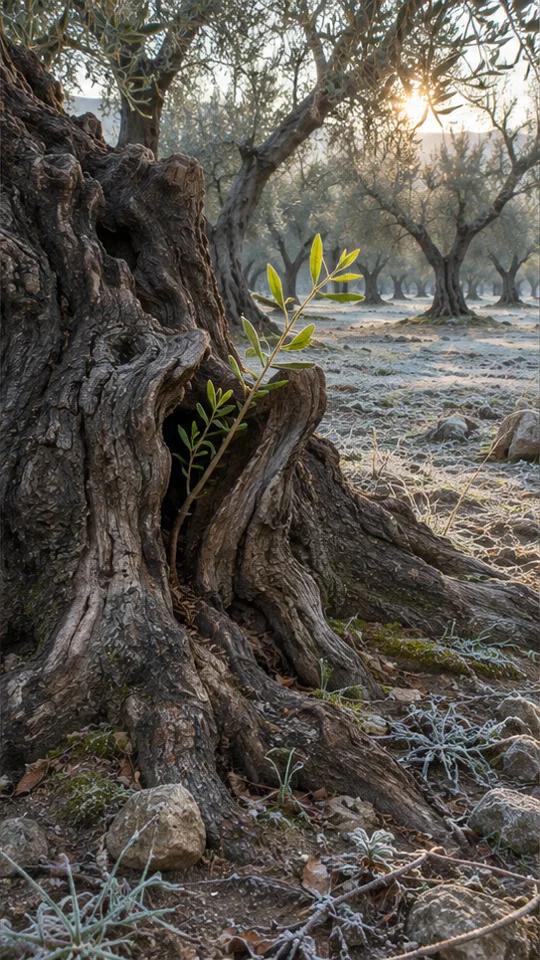
Imagine a big tree chopped down, with only a stump left. It looks dead. But one day a tiny green shoot pokes out! Isaiah said God’s people were like that tree. Many of their kings had let them down, but God would make a new king grow from the family of Jesse, King David’s father. Christians believe that king is Jesus.
Key takeawayWhen something looks finished, God can make new life grow from it.
Simple
Jesse was the father of King David, and David’s family had ruled Judah for a long time. Many of its kings had failed. Isaiah pictures the family as a tree cut down, with only the stock left. Yet a fresh shoot will grow from it and bear fruit. The verses after it describe this new king: God’s Spirit rests on him, and he judges the poor fairly.
Key takeawayGod’s promise to David’s family did not die when its kings failed.
Standard
Chapter 10 ends with the Lord felling a forest: the tall are cut down and Lebanon falls (10:33–34). Chapter 11 begins with and, so the shoot rises from that wreckage. The prophet names Jesse rather than David, which a Catholic study note reads as a new beginning from the family’s origin, after the failure of the historical kings. Verse 2 then gives the shoot the LORD’s Spirit, with wisdom, understanding, counsel, might, knowledge and the fear of the LORD. Verses 3–5 make him a judge who defends the poor, verses 6–9 picture the wolf living with the lamb, and verse 10 calls him the root of Jesse, sought by the nations.
Key takeawayThe forest falls in chapter 10, and from its stump comes the king who brings justice and peace.
Scholar
The verse is two parallel lines: shoot answers branch, and the stock of Jesse answers his roots, with a verb at each end. The opening perfect with waw carries on the prophecy of 10:33–34, and the closing imperfect says the branch will be fruitful. Geza is rare, used of a tree’s stock in Job 14:8 and Isaiah 40:24, and Job 14:7 hopes that a felled tree will sprout again. The date is debated: a Catholic study note credits Isaiah and sees no particular historical person in view, while Michael Chan finds it hard to say what event, if any, lies behind the stump. The Targum renders the verse as a king from the sons of Jesse, the Messiah. Paul quotes verse 10 in Greek form at Romans 15:12, and Revelation 5:5 calls Jesus the Root of David. The Latin virga, rod, later invited readings about Mary.
Key takeawayTwo balanced lines turn a felled tree into a royal promise that Jews and Christians both read of the Messiah.
Key words
In the original Hebrew word order, read right to left. Choose a word to see what it means and why it matters.
will come out
וְיָצָ֥א veyatza’
it will go out
Veyatsa joins and to yatsa, to go or come out. STEPBible’s tagging gives this use the sense of issuing or sprouting, as a plant comes out of the ground. The form is a perfect with waw, which in prophecy usually looks forward, so it reads as a future, and its and links the verse to 10:33–34.
Why it mattersThe verse starts with and, tied to the felled forest just before it. Out of that wreckage something comes out alive.
Qal perfect with waw, 3rd person masculine singular · Strong’s H3318
A shoot
חֹ֖טֶר choter
a shoot
Choter is a branch, twig or rod, according to STEPBible’s lexicon. In its tagged Hebrew text the word appears only here and in Proverbs 14:3, for the rod a fool’s talk brings on his back. Rashi read it as a sign of the royal scepter, and the Latin Vulgate renders it virga, a rod.
Why it mattersWhat appears first is small, a twig, set against the tall trees and the cedars of Lebanon felled in 10:33–34.
Noun, masculine singular absolute · Strong’s H2415
out of the stock of
מִגֵּ֣זַע migeza’
from the rootstock of
Mi-geza joins from to geza, the stem, trunk or stock of a tree. It is rare: STEPBible’s tagged text has it only here, in Job 14:8 for a tree’s stock that dies in the ground, and in Isaiah 40:24. After the felling of 10:33–34, it pictures what is left once the tree is cut.
Why it mattersThe family of Jesse is pictured as a tree cut down. The hope begins exactly where the dynasty looks finished.
Noun, masculine singular construct · Strong’s H1503
Jesse
יִשָׁ֑י yishai
Jesse
Yishai is Jesse of Bethlehem, son of Obed and father of King David (Ruth 4:17; 1 Samuel 16:1). The prophet names the father, not David. A Catholic study note sees here a new beginning, springing from the very origin from which David and his dynasty arose.
Why it mattersNaming Jesse goes back behind the kings to the family’s humble start, as if David’s line were being planted again.
Proper noun · Strong’s H3448
and a branch
וְנֵ֖צֶר venetzer
and a sprout
Netser is a sprout, shoot or branch, and STEPBible’s lexicon notes that it is always figurative. Isaiah 60:21 calls God’s people the branch of his planting with the same word. Jeremiah 23:5 and Zechariah 6:12 speak of a Branch for David too, but with a different Hebrew word.
Why it mattersA Catholic study note on Matthew 2:23 suggests this word lies behind Nazarene. If so, Jesus’ hometown echoes this verse, though the link is debated.
Noun, masculine singular absolute · Strong’s H5342
out of his roots
מִשָּׁרָשָׁ֥יו misharashav
from his roots
Mi-shorashav joins from, the plural of shoresh, root, and the suffix his, pointing back to Jesse. The lexicon includes roots of people, a figure for firmness or permanence. In verse 10 the same word becomes a title, the root of Jesse, and Isaiah 53:2 pictures a root out of dry ground.
Why it mattersNew life rises from what is hidden underground. The roots survive even when the trunk above has gone.
Noun, masculine plural construct, with 3rd person singular suffix · Strong’s H8328
will bear fruit
יִפְרֶֽה yifreh
it will be fruitful
Yifreh is an imperfect of parah, to bear fruit or be fruitful, the verb God speaks in Genesis 1:28, be fruitful. The Latin Vulgate says instead that a flower will rise up from the root, the wording behind many medieval pictures of Christ as the flower on Jesse’s tree.
Why it mattersThe verse goes beyond survival. The shoot will grow and bear fruit, which verses 2–9 describe as justice and peace.
Qal imperfect, 3rd person masculine singular · Strong’s H6509
Where the verse sits
Isaiah 11:1 opens a poem about a coming king. It begins with and, answering the end of chapter 10, where the Lord cuts down a forest and Lebanon falls. From what is left of Jesse’s family tree, David’s line, a new shoot grows, and the verses that follow describe his reign.
- 10:33–34
The Lord of Armies lops the boughs and cuts down the forest; the tall and the lofty are brought low.
- v. 1
You are here. A shoot comes out of the stock of Jesse, and a branch from his roots bears fruit.
- vv. 2–5
The LORD’s Spirit rests on him, and he judges the poor with righteousness, wearing faithfulness like a belt.
- vv. 6–9
The wolf lives with the lamb, a little child leads them, and the earth is full of the knowledge of the LORD.
- v. 10
The root of Jesse stands as a banner of the peoples, and the nations seek him.
- vv. 11–16
The Lord gathers the remnant of his people from many lands, with a highway out of Assyria.
A felled forest and a stump
Isaiah 10:33–34 shows the Lord lopping boughs and cutting down the thickets of the forest with iron. Michael Chan names the fall of proud Assyria as one possible meaning. Chapter 11 starts with and, so the shoot appears right after the felling. A Catholic study note says the image suggests the bankruptcy of the monarchy and the need for a new beginning.
Why Jesse, not David?
Jesse was a man of Bethlehem, the grandson of Boaz and Ruth and the father of David (Ruth 4:17). The LORD sent Samuel to his house to anoint a king among his sons (1 Samuel 16:1). By naming Jesse, the prophet goes back before the throne to the family’s beginning. The promise to David’s house stands, but it grows again from the root.
When was it written?
The date is debated. A Catholic study note reads verses 1–9 as Isaiah’s, from the eighth century BC, with no particular historical person in mind, and calls verses 10–16 probably much later. Michael Chan finds it hard to say what event lies behind the stump, naming the exile, Assyria’s fall and the young Josiah, and notes the image fits many moments in Israel’s history.
Common misreadings
A common reading
The shoot grows from a healthy, flourishing royal tree.
Closer to the text
The verse speaks of the stock, what remains of a trunk, right after 10:33–34 has cut the forest down. A Catholic study note reads it as the failure of the historical kings. The hope is new life from what looks dead, not a dynasty at its height.
A common reading
Isaiah’s branch is the same word as Jeremiah’s Branch.
Closer to the text
Jeremiah 23:5, Zechariah 6:12 and Isaiah 4:2 use one Hebrew word for Branch, and Isaiah 11:1 uses another, netser. The images are related, new growth for David’s line, but the vocabulary differs, and that matters for the link some see with Nazarene in Matthew 2:23.
A common reading
This prophecy meant nothing until Jesus was born.
Closer to the text
The poem follows a real threat in chapter 10 and gave hope to Judah about its kings. The Targum and Rashi read it of the Messiah, and Christians see it fulfilled in Jesus. A first meaning for Isaiah’s hearers and its fulfillment in Christ can both be held.
How traditions read it
Jews and Christians both read the shoot of Jesse as the promised king of David’s line; they differ on who he is and whether he has come.
Jewish
The Aramaic Targum renders the verse as a king from the sons of Jesse, with the Messiah anointed from his descendants. Rashi reads it as consolation that the King Messiah will come and redeem the exiles. Isaiah 10:32–12:6 is the haftarah for the eighth day of Passover.
Catholic
Isaiah 11:1–10 is read on the Second Sunday of Advent in Year A and on Tuesday of Advent’s first week. The Catechism sees the Messiah’s features here (712) and names the seven gifts of the Spirit, citing verses 1–2 (1831). Tertullian called Mary the stem and Christ its blossom.
Read it with these verses
- Isaiah 11:2The next verse fills in the shoot: the LORD’s Spirit rests on him with wisdom, counsel and might.
- Isaiah 11:10The word for root returns as a title, the root of Jesse, a banner sought by the nations.
- Job 14:7–9Job hopes for a felled tree that sprouts again, using the same rare word for stock.
- 1 Samuel 16:1–13The LORD sends Samuel to Jesse’s house, and the Spirit comes on David when he is anointed.
- Romans 15:12Paul quotes Isaiah on the root of Jesse who rises to rule the Gentiles, of Christ.
- Revelation 5:5Christ is called the Root of David, who has overcome and can open the sealed book.
Live it this week
- Where does something in your life feel cut down to a stump, past the point where you expect new growth?
- The shoot’s fruit is justice for the poor and humble (v. 4). Whom could you treat with that kind of fairness this Advent?
- Christians see the shoot fulfilled in Jesus. How will you stay rooted in him through the weeks ahead?
A short prayer
Lord Jesus, shoot of Jesse, you came up from what looked dead. Where my life feels cut down, make something new grow. Let your Spirit rest on me, and let my days bear fruit in justice and peace. Amen.
To pray with this verse more slowly, try lectio divina, the Church’s ancient way of praying with Scripture.
Memorize it
Say the verse aloud, then hide more words. Tap a blank to peek.
Teaching Isaiah 11:1
For parents, small-group leaders and preachers.
With kids
Show a picture of a tree stump, or find one outside, and ask: Can anything grow from this? Then tell them Isaiah said a new king would grow from a chopped-down family tree. Read the Kids level above together, and look for green shoots.
Small group questions
- Read 10:33–11:1 together. What does the felled forest add to the picture of the shoot?
- Why might Isaiah name Jesse instead of David? What does that suggest about the new king?
- Verses 2–9 describe the shoot’s fruit. Which part surprises you most, and why?
Sermon outline
- The forest felled (10:33–34)
- The shoot from the stock (v. 1a)
- The branch that bears fruit (v. 1b)
- The Spirit that rests (v. 2)
- The peace that follows (vv. 6–9)
Questions people ask
Who is the shoot of Jesse in Isaiah 11:1?
Christians identify the shoot with Jesus, born of David’s line, and the New Testament calls him the root of Jesse and the Root of David (Romans 15:12; Revelation 5:5). Jewish tradition reads it of the Messiah, as the Targum does. A Catholic study note says the oracle does not seem to have a particular historical person in mind, only a new king who realizes David’s ideals.
What is the stump of Jesse?
It is the picture of David’s family as a tree cut down, with only its base left. The Hebrew word, translated stock in this verse, is the stem or trunk that remains, used in Job 14:8 of a tree whose stock dies in the ground. A Catholic study note says the image suggests the failure of the historical kings and the need for a new beginning.
Who was Jesse in the Bible?
Jesse was a man of Bethlehem, the son of Obed and grandson of Boaz and Ruth, and the father of King David (Ruth 4:17–22). The LORD sent Samuel to his house to anoint one of his sons king, and Samuel anointed David, the youngest (1 Samuel 16:1–13). Jesse appears in the family tree of Jesus in Matthew 1:5–6 and Luke 3:32.
Is Isaiah 11:1 connected to Nazareth?
Possibly. Matthew 2:23 says Jesus would be called a Nazarene, though no Old Testament verse says that in those words. A Catholic study note suggests Matthew heard a link with netser, the branch of Isaiah 11:1, or with nazir, one consecrated to God, as Samson was (Judges 13:5). The connection is a suggestion, and scholars debate it.
What is a Jesse tree?
A Jesse tree takes its name from this verse. In medieval art it shows the ancestors of Christ growing on a tree that rises from Jesse, as in the twelfth-century window at Chartres Cathedral. The modern Advent Jesse tree is a branch or poster hung with symbols of the Bible stories that lead up to Christmas, used especially to teach children.
When is Isaiah 11:1 read at Mass?
Isaiah 11:1–10 is the first reading on the Second Sunday of Advent in Year A, as on 7 December 2025, and on Tuesday of the First Week of Advent, which in 2026 is 1 December. On 19 December the Gospel acclamation calls on the Root of Jesse to come to save us without delay.
How is Isaiah 11:1 different from Isaiah 11:10?
Isaiah 11:1 pictures the king as a shoot growing out of Jesse’s roots. Isaiah 11:10 calls him the root of Jesse itself, standing as a banner that the nations will seek. A Catholic study note treats verse 10 as an elaboration of the prophecy. Paul quotes verse 10, in its Greek wording, in Romans 15:12 to show that the Gentiles hope in Christ.
How can I explain Isaiah 11:1 to a child?
Use a tree stump. Explain that God’s people were like a tree that had been chopped down, but God promised that a new green shoot would grow from it, a king from David’s family. Christians believe that king is Jesus. Choose the Kids level above to read a version aloud, then look together for a stump or a sprouting plant.
In culture
This verse gave Christian art the Tree of Jesse, a family tree of Christ rising from Jesse, and the oldest complete window of the subject, at Chartres Cathedral, dates from about 1145. Because the Latin calls the shoot virga, close to virgo, virgin, Mary is often shown as the rod and Christ as the flower. The German carol Es ist ein Ros entsprungen, thought to date from the fifteenth century, sings of a rose sprung from Jesse’s line, in Michael Praetorius’s harmony of 1609.
Keep reading
Sources
Every verse is quoted word for word, and every Catechism paragraph below was checked on the Vatican’s published text.
Scripture
- Isaiah 10:33–34
- Isaiah 11:1–16
- Isaiah 4:2
- Isaiah 10:32
- Isaiah 12:6
- Isaiah 40:24
- Isaiah 53:2
- Isaiah 60:21
- Genesis 1:28
- Ruth 4:17–22
- Judges 13:5
- 1 Samuel 16:1–13
- Job 14:7–9
- Proverbs 14:3
- Jeremiah 23:5
- Zechariah 6:12
- Matthew 1:5–6
- Matthew 2:23
- Luke 3:32
- Romans 15:12
- Revelation 5:5
- Isaiah 11:2
- Isaiah 11:10
Other sources
- Catechism of the Catholic Church, 712, 1831
- New American Bible, Revised Edition, notes on Isaiah 11:1–16, 11:1–9, 11:1, 11:2–3 and 11:10–16, Matthew 2:23 and Revelation 5:5 (USCCB, bible.usccb.org)
- Lectionary for Mass, Second Sunday of Advent, Year A, no. 4 (USCCB daily readings, 7 December 2025); Tuesday of the First Week of Advent, no. 176 (1 December 2026); Gospel acclamation for 19 December (USCCB daily readings, 19 December 2025)
- Tertullian, On the Flesh of Christ, 21 (New Advent)
- Targum Jonathan on Isaiah 11:1, 1871 translation (Sefaria)
- Rashi on Isaiah 11:1, Judaica Press translation (Sefaria)
- Jewish Theological Seminary, “Pesah Day 7 & 8” haftarah commentary
- Michael J. Chan, “Commentary on Isaiah 11:1–10,” Working Preacher (Luther Seminary), 4 December 2016
- Clementine Vulgate, Isaiah 11:1 (sacred-texts.com and latinprayer.org)
- “Tree of Jesse” and “Es ist ein Ros entsprungen,” Wikipedia
- STEPBible.org, tagged Hebrew text and lexicon (CC BY 4.0), for the original words, Strong’s numbers and grammatical forms
Scripture is quoted word for word from the World English Bible, Catholic Edition. Images are artistic interpretations.